













Why Soft Metro Vancouver Water Still Spots Glass
Soft water can still leave spots on shower glass. Learn what causes the haze in Metro Vancouver and how to clean and prevent buildup without damaging your shower door.
You have probably heard that Metro Vancouver has soft water. So why do your glass shower doors still develop white spots, streaks, or a cloudy film?
The short answer is that soft water is not residue-free water. Water hardness measures particular dissolved minerals, mainly calcium and magnesium. It does not measure everything that can remain on glass after a shower. Soap, conditioner, body oils, and even cleaning products can contribute to the haze.
That distinction matters because treating every mark as hard-water scale can lead to unnecessary scrubbing or the wrong cleaner. A better approach is to understand what may be collecting on the glass, remove it safely, and reduce how much water and product residue dries there between cleanings.
What “Soft Water” Actually Means
Water hardness describes the concentration of dissolved calcium and magnesium in water. Hard water contains more of these minerals; soft water contains less.
Metro Vancouver’s drinking water is generally soft. The region’s annual water-quality report is a useful public reference for understanding the municipal supply, including reported water characteristics and how quality is monitored.
But “soft” is a classification, not a promise that water will dry invisibly on every surface. Soft water can still contain dissolved substances. When a droplet evaporates, the water leaves as vapor while nonvolatile material can remain.
Think of the difference between a small amount of residue and no residue at all. One shower may leave very little behind. Repeated showers, especially when droplets dry on the same areas of glass, can make that small amount increasingly noticeable.
A water-quality report cannot diagnose your shower door
A regional report describes the water supply. It does not analyze the film on an individual bathroom surface.
That film also reflects what happens inside your home: which products you use, how much water stays on the glass, how often the enclosure is cleaned, and whether previous cleaners have been thoroughly rinsed away.
The report provides context. It cannot establish whether a particular white mark is mineral residue, soap buildup, or a combination.
What Gets Left Behind When Shower Water Dries?
Fresh shower water does not stay chemically separate from everything it touches. It mixes with personal-care products, material washed from skin and hair, and anything already on the enclosure.
By the time a droplet settles on the glass, it may carry more than the dissolved substances that arrived through the plumbing.
Traces of dissolved minerals
Lower mineral content generally means less potential for mineral deposits than in a hard-water area. It does not eliminate that potential.
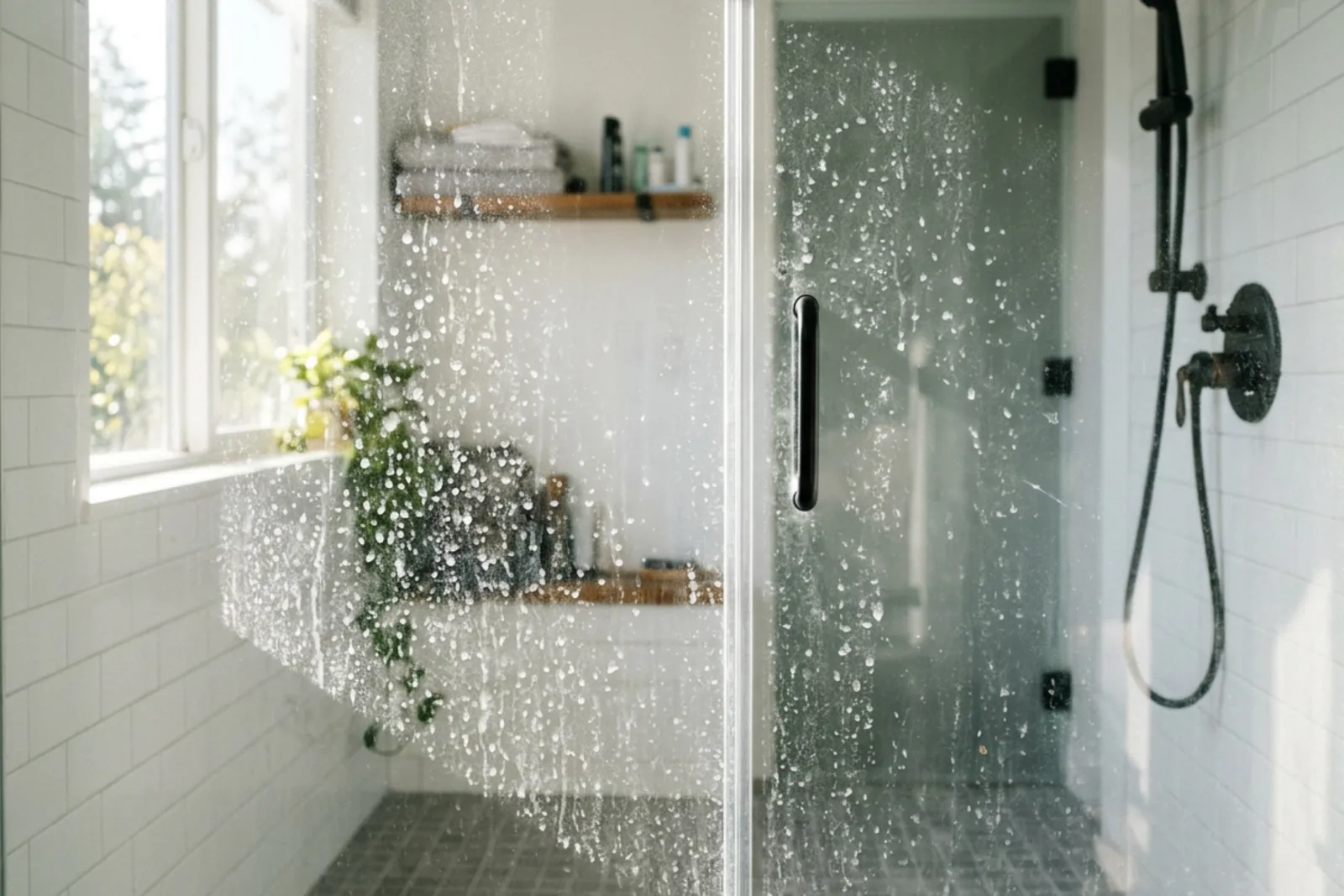
As water evaporates, dissolved substances become more concentrated in the shrinking droplet. Material may collect around its edge, leaving a ring or pale outline. Across a shower door, many small deposits can create a speckled appearance.
These marks are often easiest to see on dry glass under angled light. The same door may look much clearer while wet because water temporarily changes how light passes through surface irregularities and deposits.
Soap and personal-care products
Traditional soap can react with calcium and magnesium to form poorly soluble residue, commonly called soap scum. Soft water reduces the minerals available for that reaction, but it does not make every soap-related deposit impossible.
Other products can leave films without that reaction. Shampoo, conditioner, moisturizing body wash, and hair treatments contain ingredients designed to cleanse, soften, or coat. Some of those ingredients can settle on nearby glass.
Body oils contribute, too. A film containing oily material may resist a cleaner intended mainly for mineral scale. This helps explain why one product can remove individual spots yet leave the door looking smeared.
Cleaning-product residue
Cleaning can sometimes add another layer to the problem.
Too much detergent, incomplete rinsing, or repeated use of a product that leaves a film can create streaks. A dirty cloth may redistribute residue rather than remove it. Fabric-softener residue on a cleaning cloth can also interfere with a clear finish.
If the glass looks streakier immediately after cleaning, reconsider the product amount and wiping method before assuming the water has become harder.
Why Buildup Becomes More Noticeable Over Time
A shower enclosure goes through repeated wetting and drying cycles. Each cycle creates another opportunity for residue to remain.
The pattern is rarely uniform. Lower sections may receive more runoff, while glass close to the showerhead gets more direct spray. Edges, seals, and hardware can hold moisture after the center of the panel has dried.
Bathroom conditions affect drying, too. High humidity can keep surfaces damp longer, while ventilation helps moisture leave the room. Neither condition removes dissolved material from water already on the glass. Removing the droplets is more direct.
That is why a frequently used shower can develop visible buildup even when the household has always had soft water. The supply may be unchanged; the deposits have simply accumulated.
Lighting can make the change seem sudden. A new bulb, daylight at a different angle, or a darker background may reveal a film that was already there.
Can You Tell What the Spots Are by Looking?
Sometimes the appearance provides clues. It rarely provides certainty.
Separate pale rings may suggest dried droplets. A broad, smeary haze may suggest product buildup. Heavier residue near the bottom of a door may relate to runoff and products collecting there.
But these patterns overlap. Mineral traces can become embedded in an oily film, and dried cleaning solution can resemble water spotting. A photograph alone may not settle the question.
Before choosing a treatment, consider the glass’s history. Did the cloudiness develop gradually? Did it appear after changing cleaners or conditioner? Does it improve after a careful wash and rinse? Is the problem spread across the panel or concentrated near hardware and seals?
For a safe comparison, clean a small, inconspicuous area using a method approved for that glass. Rinse and dry it completely before evaluating the result. Wet glass can hide remaining marks, so judging it immediately after rinsing can be misleading.
Do not use progressively stronger chemicals simply because the first attempt fails. You may be dealing with a different type of residue, a coating issue, or surface damage rather than an unusually stubborn deposit.
A Practical Cleaning Routine for Shower Glass
The best starting point is the care guidance for the enclosure. Glass coatings, metal finishes, seals, and surrounding materials may have different restrictions. A cleaner suitable for bare glass may be unsuitable for nearby stone or finished hardware.
If you do not know whether your glass has a protective coating, check the original paperwork or ask the installer or manufacturer before using a specialty treatment.
For routine maintenance, this sequence is a sensible starting point:
Check the care instructions. Choose a nonabrasive cleaner approved for the glass, any coating, and adjacent materials.
Remove loose residue. Rinse the surface if the care instructions allow it, then apply the cleaner as directed.
Clean gently. Use a clean, soft cloth or another manufacturer-approved tool. Follow the stated contact time rather than letting the product dry on the surface.
Rinse thoroughly. Remove loosened material and cleaning solution, including residue near edges.
Dry and inspect. Use a clean squeegee or soft, lint-free cloth, then assess the glass once fully dry.
More cleaner is not necessarily better. Excess product can take longer to rinse away and may leave its own film.
Be cautious with acids and abrasive tools
Vinegar and acidic bathroom cleaners are often suggested for mineral deposits. They are not universally suitable. Depending on the product and enclosure, acids may be incompatible with certain finishes, coatings, seals, or nearby natural stone.
Likewise, abrasive pads, scouring powders, razor blades, and polishing compounds can scratch or otherwise damage surfaces. Do not assume that a tool is safe just because the glass feels hard.
Never mix cleaning products. In particular, bleach must not be mixed with acids or ammonia-containing cleaners. Follow label ventilation instructions and keep products away from children and pets.
When the approved routine is not working, identifying the deposit is safer than improvising a stronger chemical combination.
How to Reduce Spots Between Cleanings
You do not need to make the bathroom spotless after every shower. A brief water-removal habit can make regular cleaning easier.
Remove standing droplets
Use a clean squeegee on accessible glass after showering, then wipe remaining water along the bottom edge if recommended by the enclosure’s care instructions. Avoid dragging hard or damaged tool edges against the glass.
The reason is simple: less water left to evaporate means less opportunity for that water to leave residue. This helps whether the droplets contain mineral traces, diluted body wash, or both.
Let the bathroom dry properly
Run the bathroom exhaust fan during showering and afterward, following the ventilation system’s guidance. Keep ventilation openings unobstructed.
Ventilation helps control humidity and dry the room. It does not replace cleaning or remove deposits already attached to glass, but it supports a more manageable bathroom environment.
Pay attention to products and cleaning tools
If a new conditioner or body wash coincides with heavier film, try rinsing overspray from the glass before it dries. You do not necessarily need to replace the product; changing where you apply it or how thoroughly you rinse may help.
Keep cleaning cloths clean and wash them according to their care instructions. A cloth carrying oil or old cleaner can turn a straightforward job into repeated streaking.
Clean often enough that residue remains easy to remove. For many households, a light, regular cleaning is less frustrating than waiting for a thick haze to develop.
Does the Type of Shower Door Make a Difference?
Frameless shower doors still spot. Removing much of the framing does not change what is in the water or personal-care products.
The practical differences are mostly about access and places where moisture collects. Framed shower doors may require attention around channels and edges. Sliding glass shower doors can have overlapping panels or tracks that make some areas harder to reach. Pivot shower doors and swing shower doors have hinges, seals, and clearances that need compatible cleaning methods.
Whatever the design, avoid forcing tools into tight spaces or soaking hardware with an unapproved cleaner. Follow the enclosure’s instructions for maintaining tracks and drainage paths.
Protective glass treatments may make some deposits easier to remove, but they do not make shower enclosures maintenance-free. Their performance and care requirements depend on the specific treatment.
When Cloudiness Needs a Closer Assessment
If an approved cleaning method removes the haze, the issue was at least partly removable surface residue. If little changes, pause before escalating.
Persistent cloudiness can involve stubborn deposits, fine scratches, chemical etching, or a damaged coating. These problems may look similar but require different responses. Cleaning cannot reverse every type of surface damage.
A qualified glass professional can assess whether further cleaning, a suitable restoration process, or another treatment is appropriate. Replacement may be necessary in some cases, but stubborn spots alone do not establish that need.
For homeowners across Metro Vancouver, the useful takeaway is straightforward: soft water and spotted shower glass are entirely compatible. Water hardness explains only part of the story. Gentle, compatible cleaning and prompt droplet removal address the everyday causes without putting the glass, coatings, or hardware at unnecessary risk.
Planning a glass project?
Send us a photo and the rough size. We will measure on site and give you a fixed written quote.
Get a Free Quote